
Key takeaway
Cognitive dissonance is the mental discomfort of holding two conflicting truths at once, and expat life produces it constantly: you can love your new home while grieving your old one, or defend your move in public while questioning it in private. It is not a flaw in your character but a normal feature of a life stretched across two worlds, closely tied to an expat identity crisis and belonging abroad. Once you learn to name it, it becomes a manageable part of expat mental health rather than a private weight you carry alone.
You built a good life here. The apartment with the light you love, the job your parents brag about, the city you defend fiercely at dinner parties. And yet every Sunday call home ends with a knot in your chest, because your mother mentions the empty chair at the table and you feel like a traitor for being so happy so far away. You tell friends here that you are never going back. You tell your family you might come home next year. You are not lying to either of them. You just cannot yet hold both truths in the same hand. That divided feeling is called cognitive dissonance, and it is one of the most common and least talked-about parts of an expat identity crisis and belonging abroad. It is not a flaw in your character, it is a normal feature of a life stretched across two worlds, and it is a manageable part of expat mental health once you learn to name it.
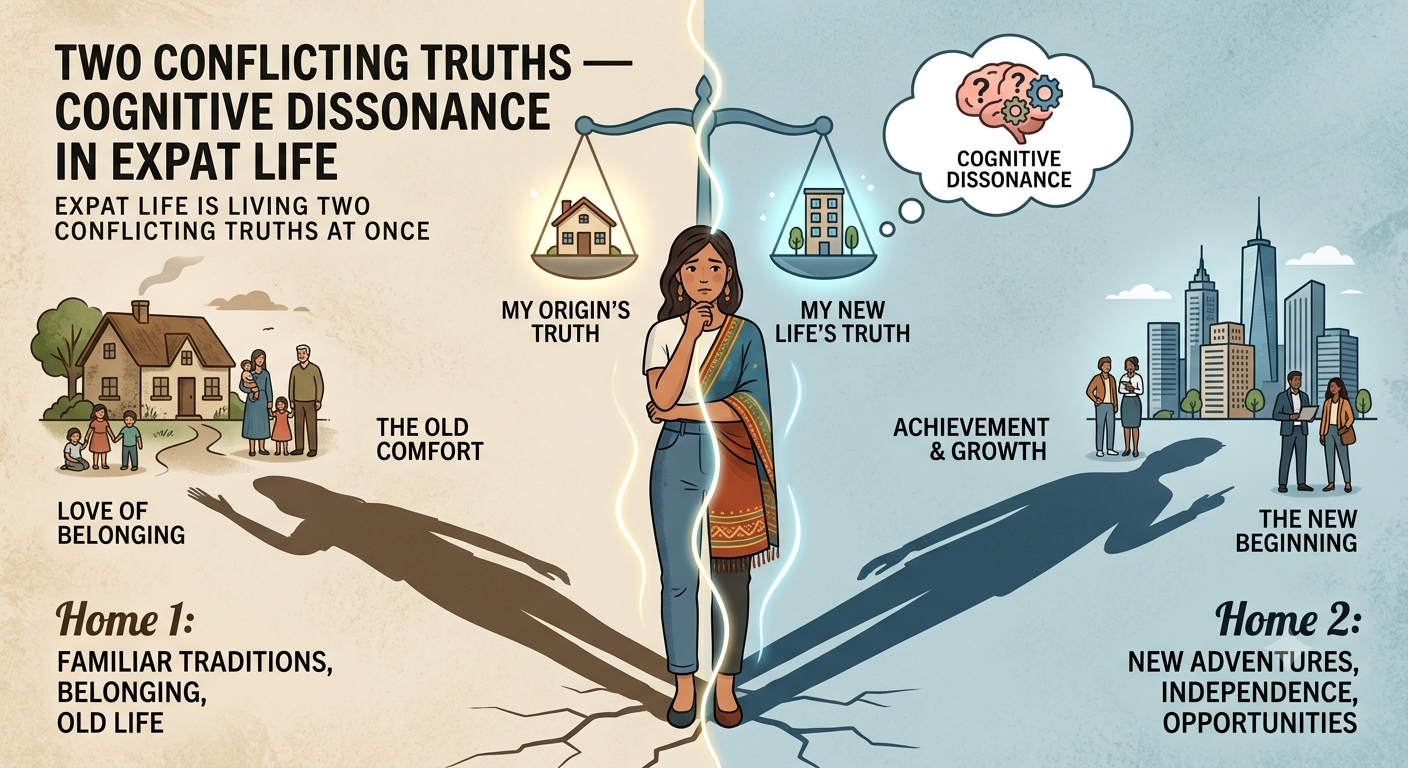
What Is Cognitive Dissonance in Expat Life?
Cognitive dissonance in expat life is the mental discomfort you feel when your beliefs, choices, identity, and behavior stop lining up. Living abroad forces constant small contradictions: you love your new home and grieve your old one, you want to belong here and fear losing who you were. That gap between two competing truths creates a persistent inner tension.
You do not need a psychology background to recognize it. The concept comes from social psychologist Leon Festinger, whose 1957 theory described the discomfort we feel when we hold two conflicting ideas and the pressure that builds to resolve it. Expat life produces this on repeat, because almost every day asks you to reconcile the person you were with the person this place is turning you into.
It usually shows up in a few recognizable shapes:
- Loving your life abroad while feeling guilty about the family you left behind.
- Wanting to integrate fully while quietly fearing you will lose your cultural identity.
- Staying in a relationship, job, or country that no longer feels right, because leaving would mean admitting the move did not work.
- Defending your decision loudly in public while privately questioning it at 3am.
Cognitive dissonance is the discomfort of trying to live with two conflicting truths at the same time.
What Are the Signs of Cognitive Dissonance?
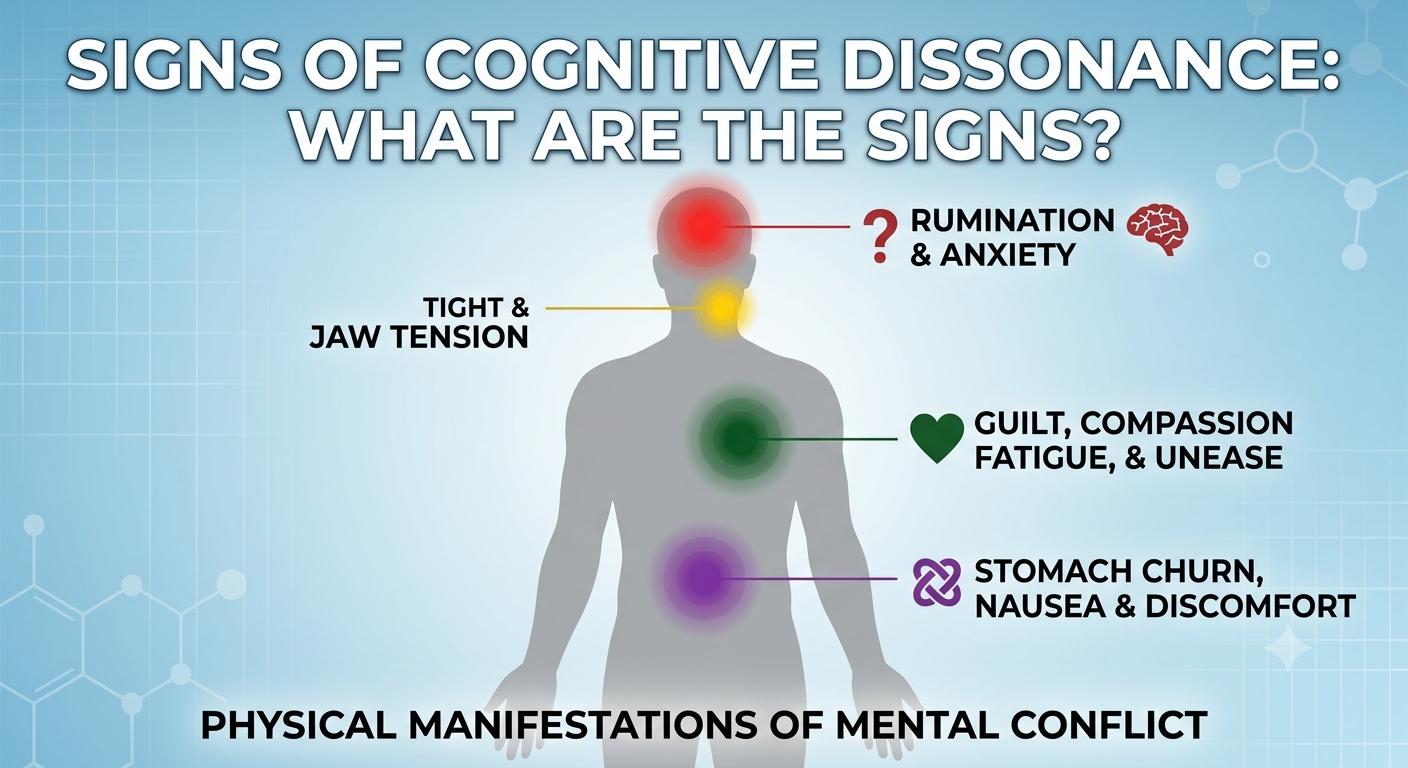
The signs of cognitive dissonance are emotional, behavioral, and physical at once. Emotionally you may feel guilt, irritability, and a low hum of anxiety. Behaviorally you might rationalize, avoid certain conversations, or keep changing how you explain your choices. Physically the strain can surface as fatigue or tension. Together, these cognitive dissonance symptoms signal an unresolved inner conflict.
The behavioral signs are often the most revealing, because they leak out before you consciously notice the conflict. You catch yourself giving three different reasons for staying abroad to three different people. You feel a flash of defensiveness when a relative innocently asks when you are "coming back for good." You dodge the topic entirely with certain friends because you cannot predict which version of your answer will come out.
Then there is the quieter layer: rumination that loops the same decision at night, emotional exhaustion that no amount of sleep fixes, and the unsettling sense of feeling unlike yourself. Some people also report psychosomatic tension, a tight jaw or a heavy stomach, that eases only when the underlying contradiction is finally spoken aloud.
Seven common signs of cognitive dissonance abroad
- Persistent guilt that flares around family contact or big life events.
- Defensiveness when someone questions your decision to live abroad.
- Chronic indecision about staying or returning home.
- Repeatedly changing the story you tell about why you are here.
- Avoiding honest conversations with people from home.
- Rumination and difficulty switching your mind off at night.
- Physical fatigue or tension with no clear medical cause.
Why Does Expat Life Create So Much Inner Conflict?
Expat life creates inner conflict because it puts your original values in direct contact with a new reality that runs on different rules. The norms you absorbed growing up, around family, money, career, and independence, no longer fit neatly into the place you now live. Every mismatch asks you to choose, and choosing between two things you value is inherently uncomfortable.
The pressure comes from many directions at once. Cultural norms you never questioned suddenly look optional. Family expectations about proximity and duty collide with a life built thousands of miles away. Even your personality shifts with language, because expressing warmth or humor in a second tongue can make you feel like a slightly different, more muted person than the one your family remembers.
Then the bigger forces stack on top. Career choices that thrilled you can strain relationships back home. Money and privilege complicate things when you can afford a life your relatives cannot access. And underneath it all sits the largest contradiction of expat existence: the unresolved question of staying abroad versus returning home, which touches everything else. If the newness of it all still feels raw, our guide to culture shock in expats unpacks that earlier layer of adjustment.
The conflict is not always between right and wrong. Often, it is between two lives that both matter to you.
Cultural Cognitive Dissonance: When Two Value Systems Collide
Cultural cognitive dissonance is the specific tension that arises when the values of your home culture and your host culture point in opposite directions. It is not a clinical diagnosis, just a useful name for a real experience: the discomfort of being fluent in two value systems that disagree, and having to decide, moment by moment, which one to live by.
It shows up in ordinary situations more than dramatic ones. You were raised to communicate indirectly and read between the lines, but your host culture prizes blunt directness, so you feel rude in one setting and evasive in the other. You value family duty above personal ambition, yet everyone around you treats individual freedom as the highest good. Work-hard ambition bumps against a local culture that guards quality of life. Expectations around dating, parenting, gender, and friendship rarely translate cleanly.
Here is the reassuring part: adaptation does not require abandoning every original value. Cultural dissonance eases when you stop treating it as a loyalty test and start treating it as a menu. You can adopt the local directness at work while keeping your family-first instincts at home. Integration is selective, not total, and choosing consciously is far less exhausting than feeling torn by default.
Why Do Expats Feel Guilty About Living Abroad?
Expats feel guilty about living abroad because distance turns love into a series of absences. You miss birthdays, illnesses, and ordinary Tuesdays. You succeed in a place your family cannot easily visit. That guilt is rarely irrational, it is the emotional cost of caring deeply about people you can no longer be physically present for, and coping with expat guilt starts with recognizing what it actually is.
The forms it takes are specific. There is guilt about missing family events you can never get back, and guilt about thriving while relatives struggle. Parents feel it sharply when their children grow up without grandparents nearby, forming accents and memories in a language the wider family does not share. There is guilt about simply enjoying a country your family cannot access, and a quieter guilt about not wanting to return, as though preferring your new life is a small betrayal of your old one.
Perhaps the heaviest is the guilt of emotional distance, the slow realization that you now understand your host-city friends better than some of the people you grew up with. None of this means you have done something wrong. It means your heart is split across a map, and that split is the price of a life that genuinely spans two places.
Expat guilt often appears because you care deeply about two places, not because you have betrayed either one.
Cognitive Dissonance and Expat Identity
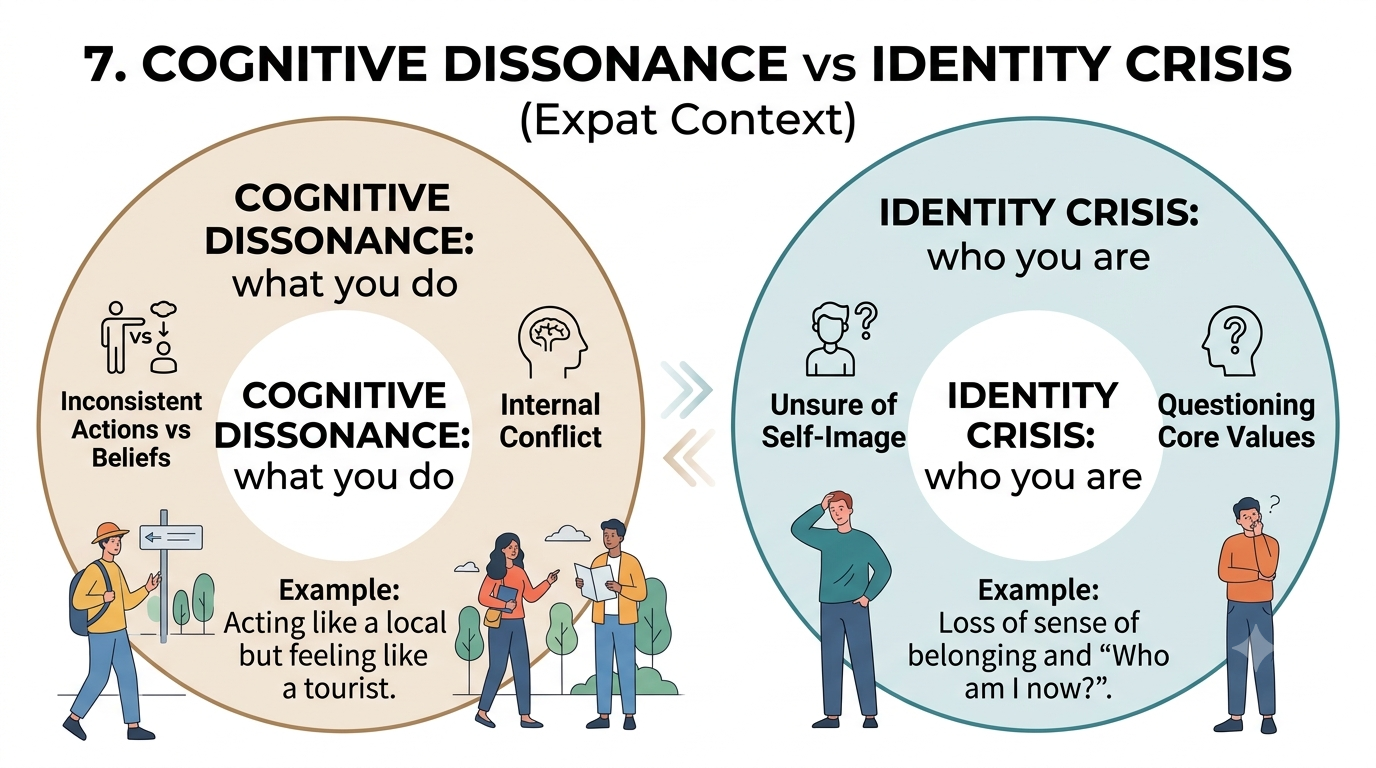
Cognitive dissonance and an expat identity crisis are related but distinct. Cognitive dissonance is a conflict between your beliefs, values, choices, and behavior, the discomfort of your actions and convictions not matching. An identity crisis is a level deeper: uncertainty about who you fundamentally are and where you belong. One is about what you are doing, the other about who you have become.
In practice they feed each other. The daily dissonance of choosing between two value systems, repeated over years, can erode your sense of a stable self until the question shifts from "am I making the right choices?" to "do I even know who I am anymore?" That is the point where dissonance has deepened into an identity question.
They call for slightly different responses, though. Dissonance is eased by aligning your actions with a chosen value. An identity crisis is eased by building a coherent, bicultural sense of self over time. If the second description fits you more than the first, our article on an expat identity crisis and belonging abroad goes into that terrain in full.
How Cognitive Dissonance Affects Decisions and Relationships
Cognitive dissonance quietly distorts the biggest decisions you make abroad. When staying or returning feels unresolved, the unresolved tension bleeds into everything downstream: relationships, careers, and long-term plans. You may hesitate to commit, not because you fear commitment itself, but because you are unsure which country, identity, or future you are committing to.
This is where the pattern often gets misread as expat commitment issues. A partner may conclude you are afraid of settling down, when the truth is more specific: it is hard to plan a shared future when you cannot answer where that future will physically be. The hesitation is about the map, not the relationship. Naming that distinction out loud can save a partnership from a painful misunderstanding.
Dissonance also shapes how you show up with people. Under its weight, expats tend to:
- Delay long-term plans, from buying a home to starting a family, while the "stay or go" question stays open.
- Present different versions of themselves to home friends and host friends, which is exhausting to maintain.
- Feel a low, confusing resentment toward a partner who represents "staying" or "leaving."
- Constantly seek reassurance that they made the right choice, because the internal verdict keeps flipping.
How to Reduce Cognitive Dissonance
You reduce cognitive dissonance not by eliminating the discomfort but by making your actions more honest. The goal is alignment, bringing at least one concrete behavior into line with a value you have consciously chosen, rather than waiting for the conflicted feeling to vanish on its own. Here is a practical, step-by-step way to work through it, and it is the core of how to reduce cognitive dissonance in expat life.
- Name the two conflicting beliefs. Write them as plain sentences: "I want to build my future here" and "I owe it to my family to come home." Naming them stops them from ambushing you.
- Separate facts from fear, guilt, and obligation. Ask what is actually true versus what is emotional pressure wearing the mask of logic.
- Identify which value matters most in this specific decision. Not forever, just for the choice in front of you now.
- Stop forcing a permanent answer too early. "Where will I live for the rest of my life?" is unanswerable today. "Where will I commit to for the next two years?" is not.
- Make one behavior align with one chosen value. Book the flight home for the holiday, or sign the longer lease. One aligned action loosens the knot faster than more thinking.
- Allow your identity to evolve. You are permitted to have changed. Growth is not disloyalty.
- Speak honestly with the people affected. Half of dissonance is the gap between what you feel and what you have told others.
- Accept that every meaningful choice has a cost. There is no option that loses nothing. Choosing the cost you can live with is the whole task.
- Review the decision after a defined period. Set a date to reassess. This turns an agonizing forever-question into a manageable experiment.
- Seek professional support when the conflict becomes persistent. If the loop will not quiet, a psychologist can help you move through it.
Protecting your baseline wellbeing makes all of this easier, so pair it with real self-care abroad. And if the tension has started tipping into worry that follows you around, our guide to anxiety while living abroad offers targeted tools.
Relief usually begins when your actions become more honest, not when every uncomfortable feeling disappears.
Can Therapy Help With Cognitive Dissonance?
Yes, therapy can genuinely help with cognitive dissonance. A psychologist gives you a structured space to name the conflicting beliefs, understand the guilt beneath them, and make hard decisions without spiraling into panic. Therapy will not tell you whether to stay or go, but it helps you reach your own answer with far less inner noise and self-blame.
A good therapist works on several fronts. They help you surface the contradictions you have been avoiding, challenge the cognitive distortions that inflate your guilt ("if I stay abroad, I am abandoning my family"), and rehearse more honest conversations with the people who matter. Crucially, they support you in integrating your two cultural identities into one self that does not have to keep choosing sides.
It is worth clarifying that cognitive dissonance therapy is not a distinct type of treatment you book by name. Instead, psychologists draw on established approaches: cognitive behavioral therapy to address distorted thinking, values exploration to clarify what truly matters to you, acceptance-based methods to sit with unavoidable trade-offs, and culturally responsive therapy that actually understands the expat context. This last point matters, because a therapist who has never lived abroad may treat your divided feeling as indecision rather than the natural weight of a cross-cultural life. Working with someone through online therapy for expats means being understood without having to explain the whole context first.
Feeling divided between the life you built and the person you used to be? Expathy connects you with a licensed psychologist who understands expat life and can support you in your native language. Find your therapist.
Frequently Asked Questions
What is cognitive dissonance in expat life?
Cognitive dissonance in expat life is the mental discomfort you feel when your beliefs, choices, identity, and behavior no longer align. Living abroad constantly puts your original values against a new cultural reality, so you end up holding two conflicting truths at once, such as loving your new home while grieving the old one. It is a normal experience, not a disorder.
What are the seven signs of cognitive dissonance?
The seven common signs of cognitive dissonance abroad are persistent guilt around family or big events, defensiveness when your choices are questioned, chronic indecision about staying or returning, repeatedly changing the story you tell about your life, avoiding honest conversations with people from home, rumination that keeps you up at night, and unexplained physical fatigue or tension. They often appear together rather than alone.
What is cultural cognitive dissonance?
Cultural cognitive dissonance is the tension that arises when your home culture and host culture hold opposing values, and you have to decide which to live by. Examples include direct versus indirect communication, individual freedom versus family duty, and different expectations around parenting or gender. It is not a clinical diagnosis, just a useful name for a real and common experience.
Why do expats feel guilty about living abroad?
Expats feel guilty because distance turns love into repeated absence. You miss family events, succeed in a place relatives cannot easily reach, and sometimes simply prefer your new life. This guilt usually reflects deep care and divided loyalty rather than any real wrongdoing. Recognizing that it comes from love, not betrayal, is the first step to carrying it more lightly.
Can cognitive dissonance cause anxiety?
Yes, unresolved cognitive dissonance can contribute to anxiety. Holding two conflicting truths without resolution keeps the mind in a state of low-grade alertness, which often surfaces as rumination, difficulty sleeping, irritability, and physical tension. Reducing the dissonance by aligning your actions with a chosen value tends to ease the anxiety that grew out of it, though persistent anxiety deserves professional support.
How do you reduce cognitive dissonance?
You reduce cognitive dissonance by making your actions more honest rather than trying to erase the discomfort. Name the two conflicting beliefs, separate facts from guilt and obligation, decide which value matters most for the decision in front of you, and bring one concrete behavior into line with it. Avoid forcing a permanent answer too early, and set a date to reassess.
What is the difference between cognitive dissonance and an identity crisis?
Cognitive dissonance is a conflict between your beliefs, values, choices, and behavior, essentially a clash in what you are doing and believing. An expat identity crisis is deeper uncertainty about who you are and where you belong. Dissonance is eased by aligning actions with values, while an identity crisis is resolved by slowly building a coherent bicultural sense of self.
Can therapy help with cognitive dissonance?
Yes. Therapy helps you identify the conflicting beliefs, understand the guilt driving them, challenge distorted thinking, and make decisions without panic. There is no standalone "cognitive dissonance therapy," but psychologists use approaches such as cognitive behavioral therapy, values exploration, acceptance-based methods, and culturally responsive therapy. A therapist who understands expat life can be especially effective, since they recognize the conflict as cross-cultural rather than simple indecision.
Need support? We're here.
Book a free 15-min consultation with our expat-specialized therapists.