
Key takeaway
Trust is one of the hardest parts of any long-distance relationship, and it gets harder when the two of you are not just in different cities but in different countries. You may love your partner deeply and still feel a knot of anxiety when they do not reply, when they go out with new friends in a place you have never seen, or when a video call ends and you realise you are building two separate lives.
- Trust in a long-distance relationship is built through small, repeated experiences of reliability, not through constant texting or perfect confidence.
- Distance rarely creates trust issues on its own, but it removes the everyday signals that normally make a relationship feel safe, which makes existing insecurities easier to trigger.
- Predictable communication reduces anxiety more than frequent communication does. Research on long-distance couples found that responsive, reliable texting predicts higher relationship satisfaction.
- Healthy long-distance trust needs both freedom and emotional reliability. Agreements protect the relationship; rules try to control the other person.
- Trust can be rebuilt after it has been damaged, but it requires accountability, transparency, consistency, and repair conversations, in that order.
- For couples living across countries, time zones, and cultures, long-distance relationship therapy for expats offers support from psychologists who understand both the relationship and the expat experience.
The problem is usually not a lack of love. The problem is that distance quietly removes most of the small signals that normally make a relationship feel safe.
When you live in the same place, trust is built almost invisibly through ordinary moments: seeing each other after work, reading body language, sharing a routine, being included in each other's world. In a long-distance relationship, many of those signals disappear. You are left relying on messages, calls, photos, time zones, and promises. That can make even a strong relationship feel fragile.
This guide explains how to build trust in a long-distance relationship without becoming controlling, emotionally dependent, or disconnected from your own life, with extra attention to what changes when you and your partner are living abroad.
Why Is Trust Harder in a Long-Distance Relationship?
Trust feels harder over distance because trust runs on information, and distance starves you of it.
You do not always know what your partner is doing, who they are with, or how they are feeling. You cannot hear tone clearly through a text. A delayed reply can feel bigger than it is. A short message can read as cold when the person was simply tired. A night out can trigger jealousy, and social media becomes a place where your mind fills in the missing information, usually with the worst version of events.
For expats and international couples, this is amplified. You may be in different countries, adapting to different cultures, juggling a five- or eight-hour time gap, and building separate social circles at different speeds. Often one partner feels settled while the other still feels like an outsider. One is surrounded by new colleagues and friends; the other is waiting alone for a call that lands at midnight their time. That imbalance, not disloyalty, is what quietly erodes trust.
Common Signs of Trust Issues in a Long-Distance Relationship
You may be dealing with long-distance trust issues if you notice yourself:
- Checking your partner's online or "last seen" status repeatedly
- Feeling anxious when they go out without you
- Overthinking delayed or short replies
- Asking the same reassurance questions again and again
- Feeling jealous of their new friends or colleagues
- Avoiding honest conversations because you fear conflict
- Feeling suspicious without a clear reason
- Needing constant proof that they still care
- Arguing about how often you should call or text
- Feeling unsure about whether the relationship has a future
These signs do not mean the relationship is doomed. They mean it needs more emotional structure, which is something you can build deliberately.
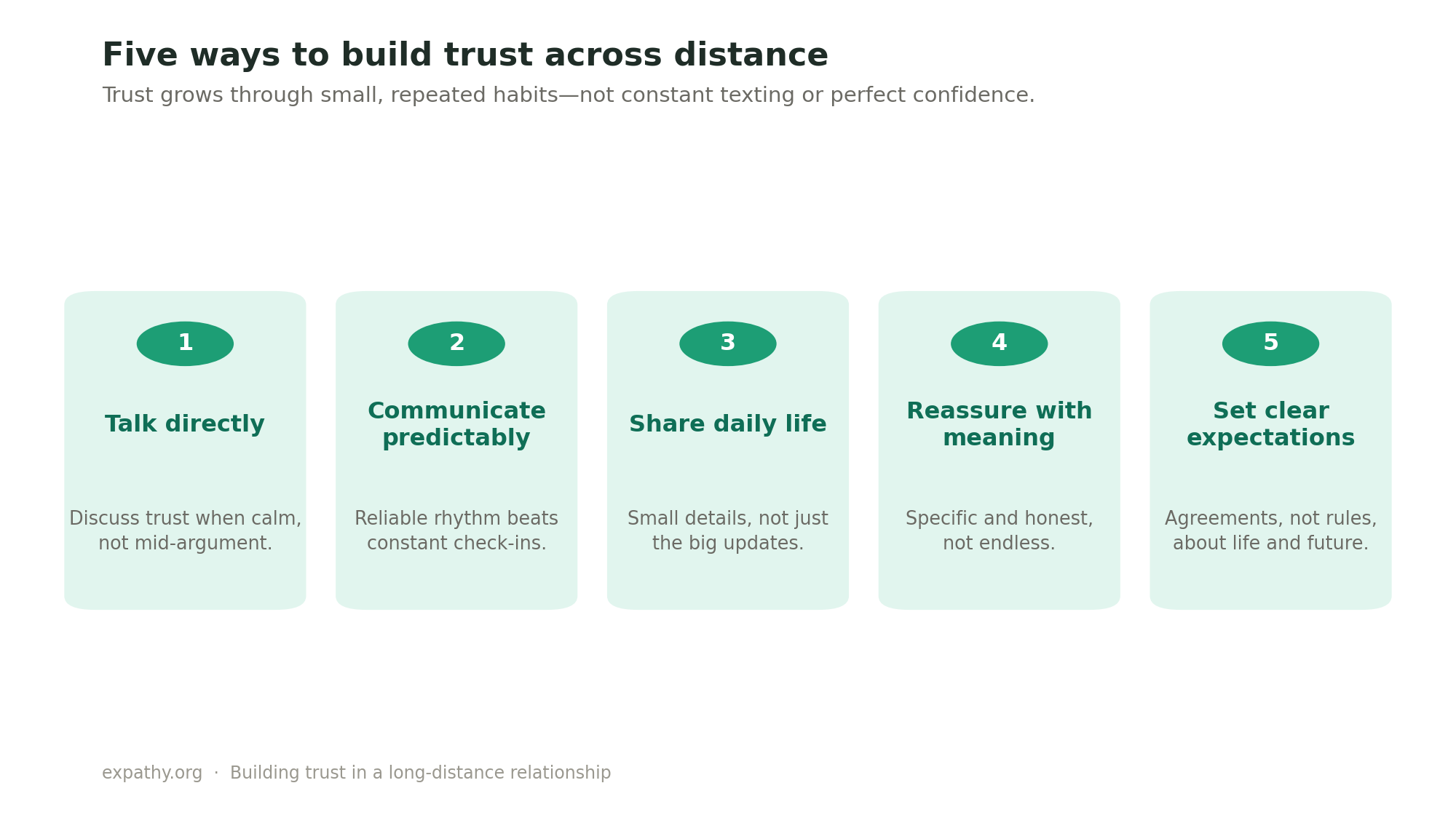
1. Talk About Trust Directly, Not Only During Arguments
Most couples only talk about trust after something has gone wrong. One partner feels ignored, the other feels accused, and the conversation turns defensive before it can become useful.
The fix is to discuss trust before the tension peaks, when you are both calm.
Instead of:
"You never make me feel secure."
Try:
"I notice I feel anxious when I don't hear from you for a long stretch. I don't want to control you. I want us to find a way to feel more connected."
That second version names the feeling, drops the blame, and invites teamwork.
A practical habit is a weekly trust check-in: a short, low-drama conversation, around twenty minutes, where you both answer a few simple questions:
- What helped you feel close to me this week?
- Was there a moment you felt unsure or disconnected?
- Is there anything we should adjust in how we communicate?
- What do you need more of from me next week?
- What did I do that helped you feel safe?
Trust grows when both partners can be honest without being punished for the vulnerability.
2. Build Predictable Communication, Not Constant Communication
Long-distance couples fight about communication because they are usually measuring it differently. One partner feels loved through frequent texting; the other prefers one deep call at the end of the day. One wants updates throughout the day; the other feels smothered by constant check-ins.
The answer is not to communicate more. It is to communicate predictably.
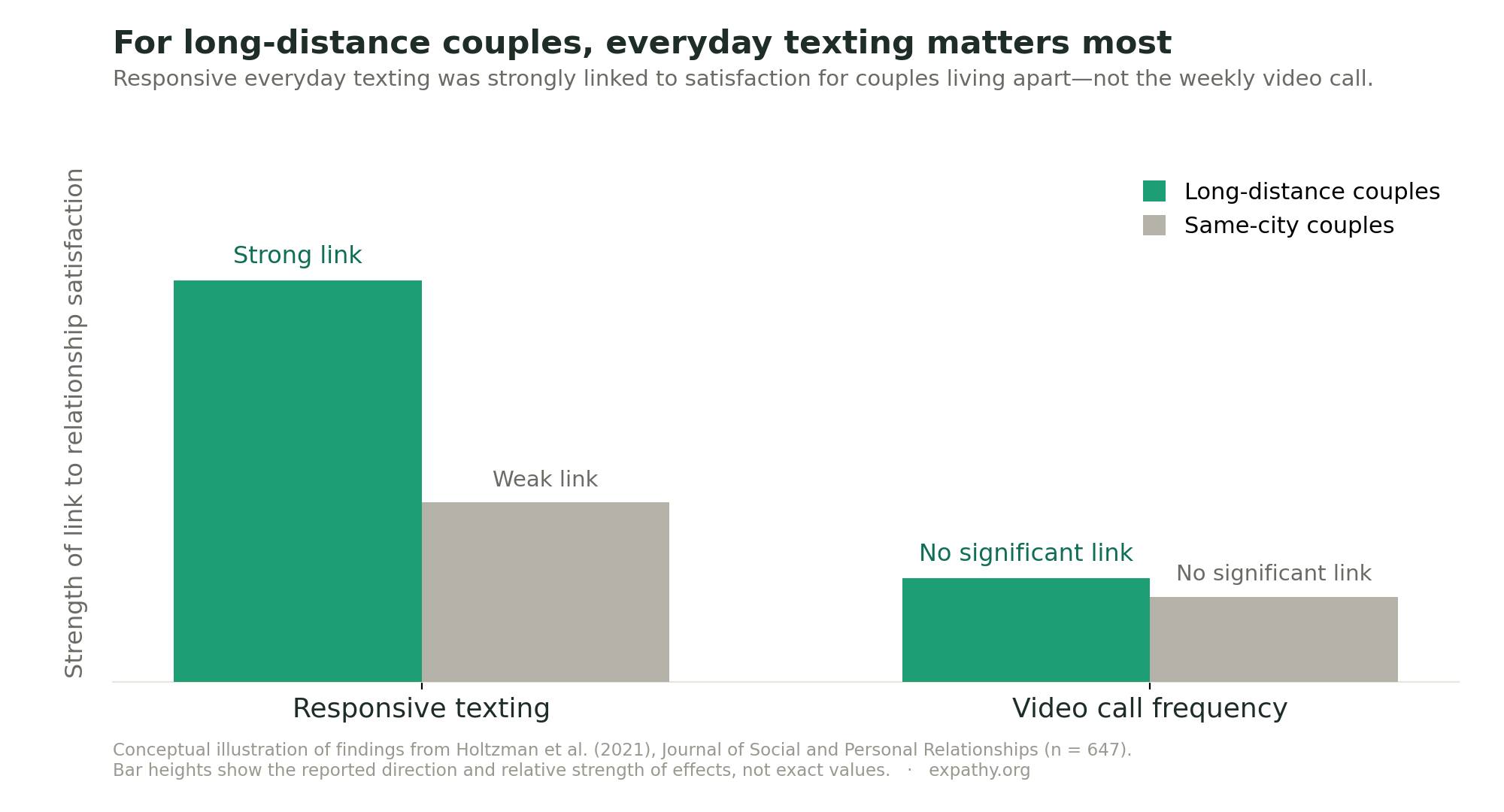
This is where the research is genuinely reassuring. A 2021 study of 647 people in the Journal of Social and Personal Relationships found that frequent and responsive texting predicted significantly higher relationship satisfaction for long-distance couples specifically, an effect that did not show up for couples living in the same city. Interestingly, the frequency of video calls was not significantly linked to satisfaction. In other words, for couples living apart, the steady reliability and responsiveness of everyday contact mattered more than the grand weekly video date.
Predictability lowers anxiety because both people know what to expect. That might look like:
- A short good-morning message
- A voice note at some point during the day
- A planned evening call a few times a week
- A longer weekend video call
- A quick message before going out
- A simple "home safe" note after a night out
The goal is for these to feel like care, not surveillance. The line between the two matters:
- Controlling sounds like: "You have to tell me everything you do."
- Caring sounds like: "It helps me feel included when I know a little about your day."
Long-distance trust is not built by removing freedom. It is built by creating enough emotional reliability that both partners can finally relax.
3. Share Your Real Daily Life, Not Just the Big Updates
Trust deepens when partners feel included in each other's ordinary life, not only the headlines.
Many long-distance couples only talk about the big things: work stress, travel plans, money, the next visit. But closeness usually lives in the small details. Tell your partner about the café you found, the colleague who made you laugh, the train that was late, the meal you cooked, the song stuck in your head, the small thing that shifted your mood.
These details help your partner picture your life and feel like they are still in it:
- A photo from your walk
- A voice note after work
- A picture of your dinner
- A funny moment from your day
- A short video of your neighbourhood
- A small frustration, shared in real time
- A "this reminded me of you" message
This matters most for expats. When one partner moves abroad, the other can feel quietly shut out of the new life being built. Sharing the small stuff says: you are still part of my world, even though you are not physically here.
4. Give Reassurance Without Making It the Whole Relationship
Reassurance is healthy. Everyone needs to feel chosen, remembered, and emotionally safe. It becomes a problem only when one partner needs it constantly and the other feels worn down by proving their love on a loop.
The aim is not endless reassurance. It is meaningful, specific reassurance.
Instead of just "Don't worry," try something concrete:
"I know the distance has been heavy this week, and I'm still completely in this with you."
"I'm going out tonight; I'll message you when I'm home. I love you, and I don't want you to feel forgotten."
"I know my replies were short today. I was buried in work, not pulling away from you."
A few specific sentences can prevent hours of overthinking.
Deep Love and Trust Messages for a Long-Distance Relationship
If you are searching for the right words to send, the most effective long-distance trust messages are not dramatic or poetic. They are honest, calm, and specific. Here are examples you can adapt to your own voice.
Reassurance messages for everyday distance:
- "I miss you, but I still feel close to you."
- "Distance is hard, but I'm not giving up on us."
- "I want you in my future, not just in my phone."
- "We're apart, but you're still part of my daily life."
- "Thank you for trusting me while we build this from far away."
Messages that rebuild a little trust after a hard week:
- "I know things felt distant this week. I'm here, and I want to fix that with you."
- "You don't have to wonder where you stand with me. You're it."
- "Even on the days I'm quiet, I'm still choosing you."
Messages for time-zone and expat realities:
- "I know I'm asleep when your day is hardest. Leave it all in a voice note and I'll wake up to you."
- "Two countries, one us. I haven't forgotten that for a second."
- "Your new life looks beautiful, and I still want a place in it."
Reassurance works only alongside real behaviour. If one partner keeps breaking promises, disappearing, or avoiding hard conversations, no message will rebuild trust on its own. At that point the relationship needs deeper repair, not better wording.
5. Set Clear Expectations About Social Life, Boundaries, and the Future
A surprising number of "trust issues" are really unspoken expectation issues. Couples often never actually agree on what feels okay and what feels uncomfortable, so each person quietly writes their own rulebook, and then someone feels betrayed by a rule the other never knew existed.
Questions worth making explicit:
- Is it okay to go out clubbing with new friends?
- Do we tell each other before going out?
- How often do we want to call?
- What counts as flirting?
- Are we exclusive?
- How do we handle friendships with ex-partners?
- When are we next seeing each other?
- Is there a plan to eventually live in the same place?
The goal here is agreements, not rules, and the difference is real:
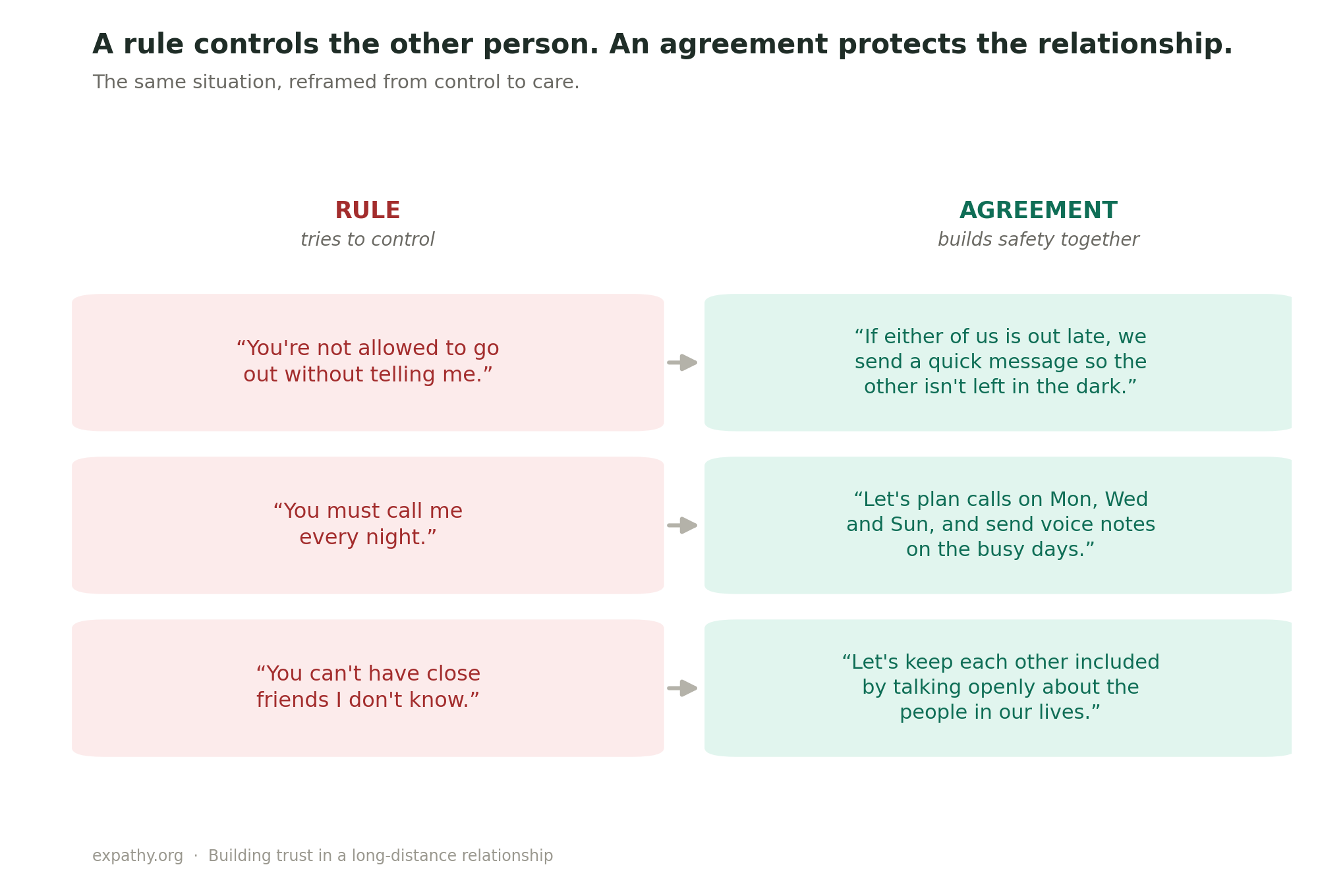
A rule controls the other person. An agreement protects the relationship.
For example:
- Rule: "You're not allowed to go out without telling me." → Agreement: "If either of us is out late, we send a quick message so the other isn't left in the dark."
- Rule: "You must call me every night." → Agreement: "Let's plan calls on Monday, Wednesday, and Sunday, and send voice notes on the busy days."
- Rule: "You can't have close friends I don't know." → Agreement: "Let's keep each other included by talking openly about the people in our lives."
Trust also needs a direction. When a relationship has no visible future, insecurity rushes in to fill the gap. You do not need every detail mapped, but you should be able to talk about:
- When you will next see each other
- Whether the distance is temporary or open-ended
- Who might eventually move, and roughly when
- What each of you needs before making a big decision
- How career, family, visa status, or cultural differences shape the plan
If you want help building that roadmap, see our guide on long-distance relationship plans.
What Not to Do When You Feel Jealous or Anxious
When trust feels shaky, it is tempting to act from fear, but fear-based behaviour almost always makes things worse. Try to avoid:
- Secretly monitoring your partner's social media
- Testing them to see whether they notice or care
- Sending a barrage of messages when they do not reply
- Accusing before asking
- Comparing yourself to their new friends
- Saying you are fine when you are not
- Using silence as punishment
- Demanding proof of love during every disagreement
Instead, pause and ask yourself a more honest question: What am I actually afraid of right now? Usually the answer is something like:
- I'm afraid they'll forget me.
- I'm afraid their new life abroad will replace me.
- I'm afraid I'm more invested than they are.
- I'm afraid there's no real future here.
- I'm afraid I can't handle this much uncertainty.
Once you can name the fear, you can express it in a way that invites closeness instead of conflict. Trust is not built by hiding insecurity. It is built by voicing it in a way your partner can actually respond to.
How to Rebuild Trust After It Has Been Damaged
Building trust is hard. Rebuilding it after lying, secrecy, emotional withdrawal, broken promises, or betrayal is harder, and positive thinking alone will not do it. Repair tends to need four things, in order.
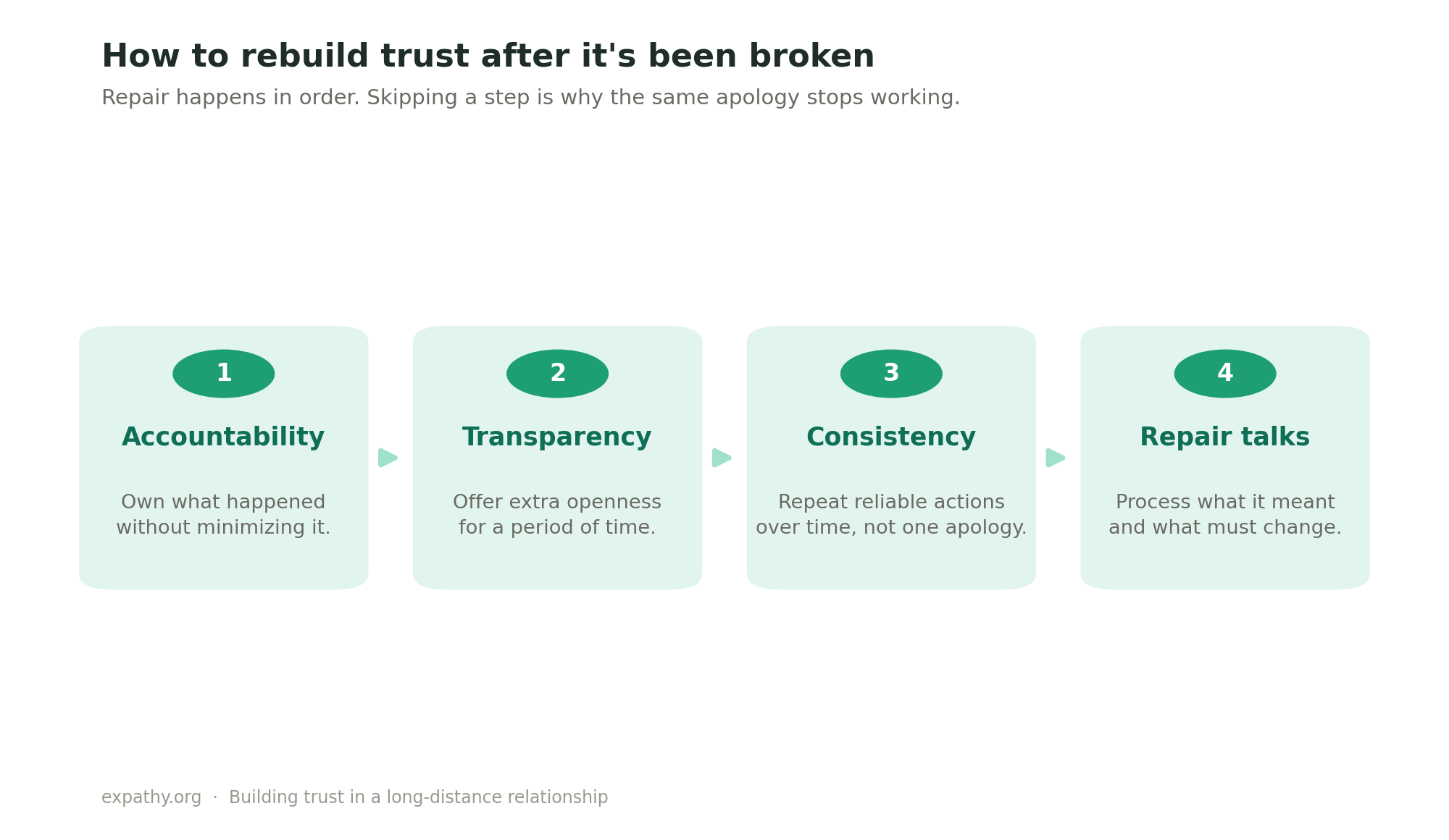
Accountability
The person who caused the damage has to be able to name what happened without minimising or deflecting it.
Transparency
For a while, the relationship may need more openness than usual. This is not permanent surveillance; it is the extra clarity the hurt partner needs to feel safe again.
Consistency
Trust comes back through repeated behaviour over time. One heartfelt apology means little if the pattern continues. Many small, reliable actions rebuild more than one big gesture.
Repair Conversations
Both partners need room to talk about what happened, what it meant, and what has to change, without the conversation collapsing into blame or panic.
If every attempt at this turns into the same argument, outside support helps. A therapist can help you see the pattern underneath the fight instead of re-litigating the incident. If distance is affecting your trust, communication, intimacy, or future plans, long-distance relationship therapy for expats gives you both a space to work through it with someone who understands life across countries and cultures.
Trust and Emotional Intimacy Are Connected
Trust is not only about believing your partner will not cheat or lie. It is also about believing they will stay emotionally present.
Plenty of long-distance couples are completely loyal but emotionally drifting. Nobody betrays anyone; they simply stop sharing feelings, asking deeper questions, or showing curiosity. That quiet distance erodes trust too, because it leaves you wondering: Do they still need me? Do they still feel close? Are we becoming strangers who keep a routine?
This is why emotional intimacy matters as much as fidelity. Trust grows when both people feel genuinely known. You can deepen that by asking better questions:
- What has felt heavy for you lately?
- When did you miss me most this week?
- What's something you've been afraid to say out loud?
- What made you feel loved recently?
- What do you need from me that you haven't asked for?
- What are you looking forward to with us?
For more on this, see our article on emotional intimacy in long-distance relationships.
When to Consider Professional Support
Some trust issues ease with better communication and clearer agreements. Others need deeper help. It may be worth speaking to a professional if:
- You keep having the same argument every week
- One partner feels constantly anxious
- One partner feels controlled or monitored
- There has been betrayal or secrecy
- Jealousy is bleeding into daily life
- You avoid important conversations to keep the peace
- You are genuinely unsure whether the relationship has a future
- Relocation stress or cultural differences are adding pressure
- You still love each other but no longer know how to feel safe
Reaching out does not mean the relationship is failing. It means you want a safer space to work things out. For broader relationship difficulties, you can explore couples therapy for expats. But when the core challenge is distance, time zones, trust, intimacy, and an uncertain future, long-distance relationship therapy is usually the more precise fit, especially with a therapist who has lived the expat experience themselves.
Frequently Asked Questions
Do long-distance relationships actually work?
Yes, many do. Long-distance relationships are not inherently weaker than same-city ones; they succeed or struggle based on the same factors, namely communication, commitment, and a shared plan for the future. Research on long-distance couples has found that frequent, responsive everyday contact is linked to higher relationship satisfaction. What tends to break long-distance couples is not the distance itself but unspoken expectations, an open-ended timeline with no plan to close the gap, and unaddressed insecurity.
How do I stop being insecure in a long-distance relationship?
Start by naming the specific fear underneath the insecurity rather than seeking endless reassurance for it. Then build predictable communication so your nervous system knows what to expect, agree on clear boundaries together, and share ordinary daily details so you both feel included in each other's lives. If the anxiety is constant or starts to feel compulsive, such as repeatedly checking their online status, talking to a therapist can help you address the root rather than just the symptom.
How often should long-distance couples communicate?
There is no universal number. What matters far more than frequency is predictability and responsiveness. A couple who reliably connects a few planned times a week, plus quick voice notes in between, often feels more secure than one that messages constantly but unpredictably. The right rhythm is whatever you both agree on, accounting for your time-zone difference, rather than a rule one partner imposes on the other.
Can trust be rebuilt after it's broken in a long-distance relationship?
It can, but it requires more than an apology. Rebuilding trust needs accountability (owning what happened), transparency (extra openness for a period), consistency (reliable behaviour repeated over time), and repair conversations where both partners can process what it meant. If you keep getting stuck in the same loop, a couples therapist can help you break the pattern rather than relive the incident.
What are the most common mistakes in long-distance relationships?
The most common are leaving expectations unspoken until someone feels betrayed, confusing frequent communication with secure communication, responding to anxiety by monitoring or testing your partner, and letting the relationship drift with no agreed plan to eventually close the distance. For expat couples, a frequent added mistake is failing to acknowledge the imbalance when one partner is settled and socially busy while the other still feels isolated abroad.
Final Thoughts
Trust in a long-distance relationship is not built through constant texting, flawless confidence, or pretending you never feel insecure. It is built through small, repeated experiences of reliability:
You say what you mean. You follow through. You repair after conflict. You include each other in daily life. You talk about the future honestly. You offer reassurance without losing yourself. You protect each other's freedom without emotionally disappearing.
Distance tests a relationship, but it also reveals what the relationship needs most. If both partners are willing to communicate clearly, respect each other's independence, and build emotional safety together, trust can grow even across countries, cultures, and time zones.
If you and your partner are navigating distance as expats, Expathy can match you with a licensed psychologist who shares your language and cultural background and understands life abroad, often within 30 seconds. Explore long-distance relationship therapy for expats.
References
Holtzman, S., Kushlev, K., Wozny, A., & Godard, R. (2021). Long-distance texting: Text messaging is linked with higher relationship satisfaction in long-distance relationships. Journal of Social and Personal Relationships, 38(12), 3543–3565. https://doi.org/10.1177/02654075211043296
Hussain, M., Price, D. M., Gesselman, A. N., Shepperd, J. A., & Howell, J. L. (2020). Avoiding information about one's romantic partner. Journal of Social and Personal Relationships.
Fonseca, A. L., Ye, T., Curran, M., Koyama, J., & Butler, E. A. (2020). Cultural similarities and differences in relationship goals in intercultural romantic couples. Journal of Family Issues.
Jiang, L. C., & Hancock, J. T. (2013). Absence makes the communication grow fonder: Geographic separation, interpersonal media, and intimacy in dating relationships. Journal of Communication, 63(3), 556–577.
Need support? We're here.
Book a free 15-min consultation with our expat-specialized therapists.